June 24, 2026
The True Cost of Disconnected Real Estate Tools
Adding an AI add-on to outdated tools sounds like progress, but for real estate agents it often creates more friction than it removes. Here is what actually moves the needle.
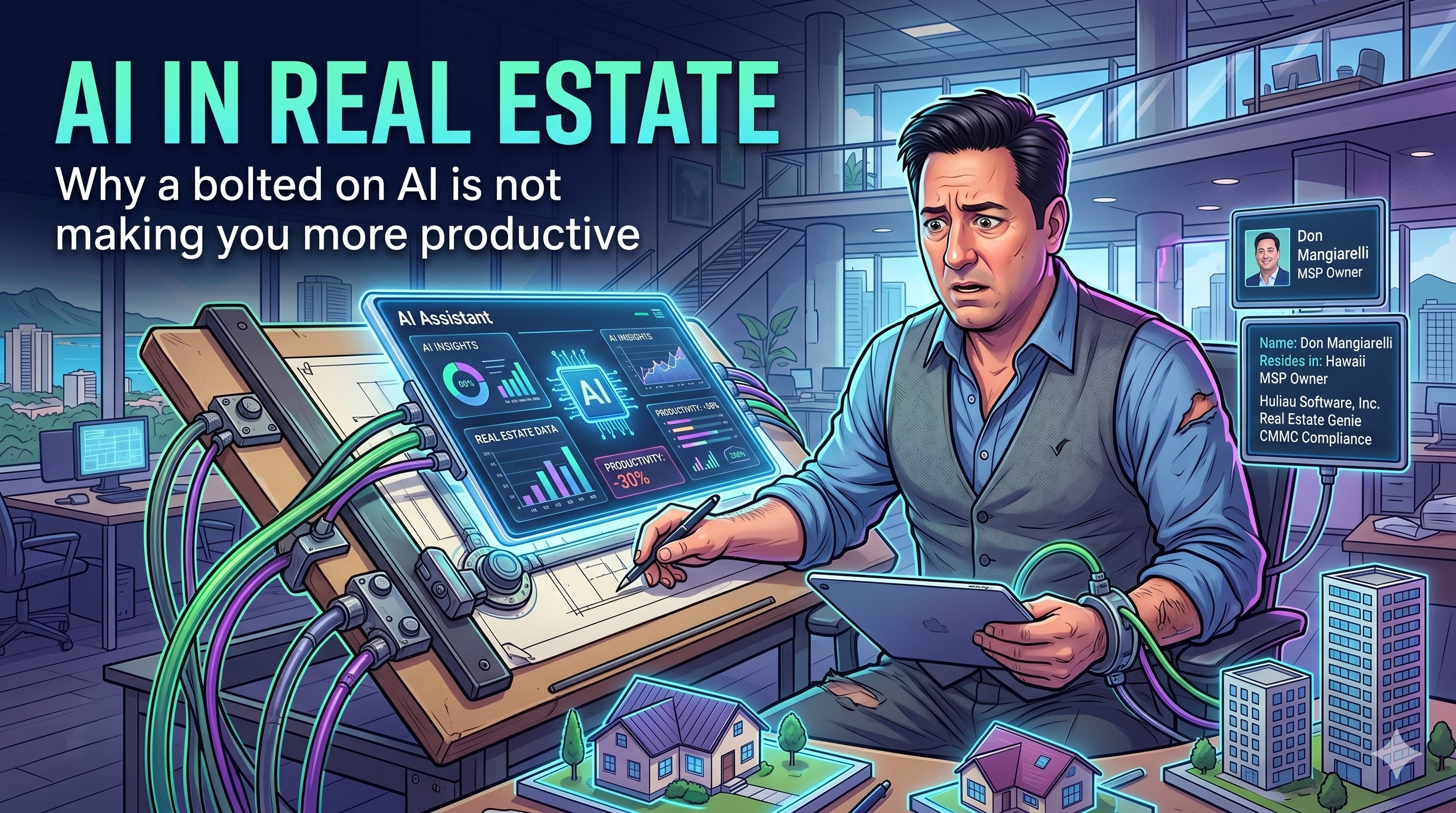
The Promise vs. the Reality of Tacked-On AI
Every software company in real estate seems to have added an "AI-powered" badge to their product over the past year. A chatbot here, an auto-complete field there, maybe a button that drafts a listing description. On the surface it looks like an upgrade. In practice, most agents find themselves doing just as much manual work as before, just with an extra step in the middle.
That gap between promise and reality is not an accident. It is a structural problem. When AI is bolted onto a fragmented tech stack, it inherits all the same inefficiencies that were already slowing you down. You do not get leverage. You get a smarter version of the same bottleneck.
Fragmentation Is the Real Productivity Killer
Think about a typical agent's day. Leads come in through one tool. Notes live in a separate CRM. Property data sits in the MLS. Follow-up tasks are in a spreadsheet or a sticky note. Transaction documents are in yet another system. Each of those handoffs is a place where time disappears and context gets lost.
Now imagine dropping an AI assistant into just one of those silos. It might be genuinely impressive inside that single tool. But the moment a client question requires information from two systems, or a follow-up task needs to trigger an action somewhere else, the AI hits a wall. You are still the connector. You are still copying, pasting, switching tabs, and re-entering data. The friction has not gone away - it has just moved one step to the right.
A tool that automates one task in a ten-step process does not change how long the process takes. It just changes which step annoys you most.
What Real Productivity Requires
Genuine productivity gains in real estate come from eliminating handoffs, not from making individual handoffs faster. That means AI needs to operate across a connected system where your leads, contacts, property data, communications, tasks, and transactions all share the same foundation.
When that foundation exists, AI can do things that actually change your day:
- Surface the right lead at the right moment - not because you remembered to check, but because the system knows the full history and flags it for you automatically.
- Draft communications in context - pulling from the actual property details, the client's search criteria, and the stage of the transaction, so the output is useful instead of generic.
- Automate follow-up sequences without gaps - because tasks, reminders, and messages all live in the same place, nothing falls through the cracks when a stage changes.
- Give you a clear picture of your pipeline - so you spend your energy on the deals most likely to close, not the ones that feel most urgent in the moment.
None of that is possible when AI is a layer sitting on top of disconnected tools. It requires data that flows freely between every part of your business.
The Hidden Cost of the Patchwork Stack
There is also a cost that rarely gets calculated: the mental overhead of managing multiple platforms. Every time you switch contexts, your brain pays a tax. Research on cognitive load consistently shows that task-switching is one of the most significant drains on focused work - and real estate agents are among the heaviest task-switchers in any profession.
Bolted-on AI does not reduce that overhead. It often increases it, because now you have to evaluate which tool to use for which task, decide when to trust the AI output, and manually reconcile information across systems. That is not productivity. That is busywork wearing a technology hat.
What to Look for Instead
If you are evaluating technology for your business - or wondering why your current stack is not delivering the efficiency gains you were promised - here are the questions worth asking:
- Is the AI working from a unified data source? If it cannot see your full client history, transaction stage, and communication record at once, its suggestions will always be incomplete.
- Does automation trigger across the whole workflow? A follow-up sequence that only lives in one module is not a workflow. It is a reminder with extra steps.
- How many tools do you need open to complete one task? If the answer is more than one, you are still paying the fragmentation tax.
- Is the AI reducing decisions or just informing them? The most valuable automation removes low-value decisions from your plate entirely, so you can focus on the judgment calls that actually require you.
See how AI can work FOR you here
Integration Is the Feature
The agents and brokerages seeing real gains from AI are not the ones who found the cleverest add-on. They are the ones who invested in a connected platform where AI has full context, actions flow automatically, and no one has to play the role of human middleware between their own tools.
If your current software required you to add AI on top of it rather than build it throughout, that is worth paying attention to. The question is not whether you have AI. The question is whether the AI you have can actually see your whole business - and act on what it sees.
That is the difference between a feature and a foundation. Real Estate Genie is built as the latter. See how it all fits together.
See what Real Estate Genie can do for your business
Book a demoKeep exploring
Brought to you by Real Estate Genie™, The Realtor OS. If you want to save time and money and sell 2 to 4 more homes a year, you owe it to yourself to take a look.