July 25, 2026
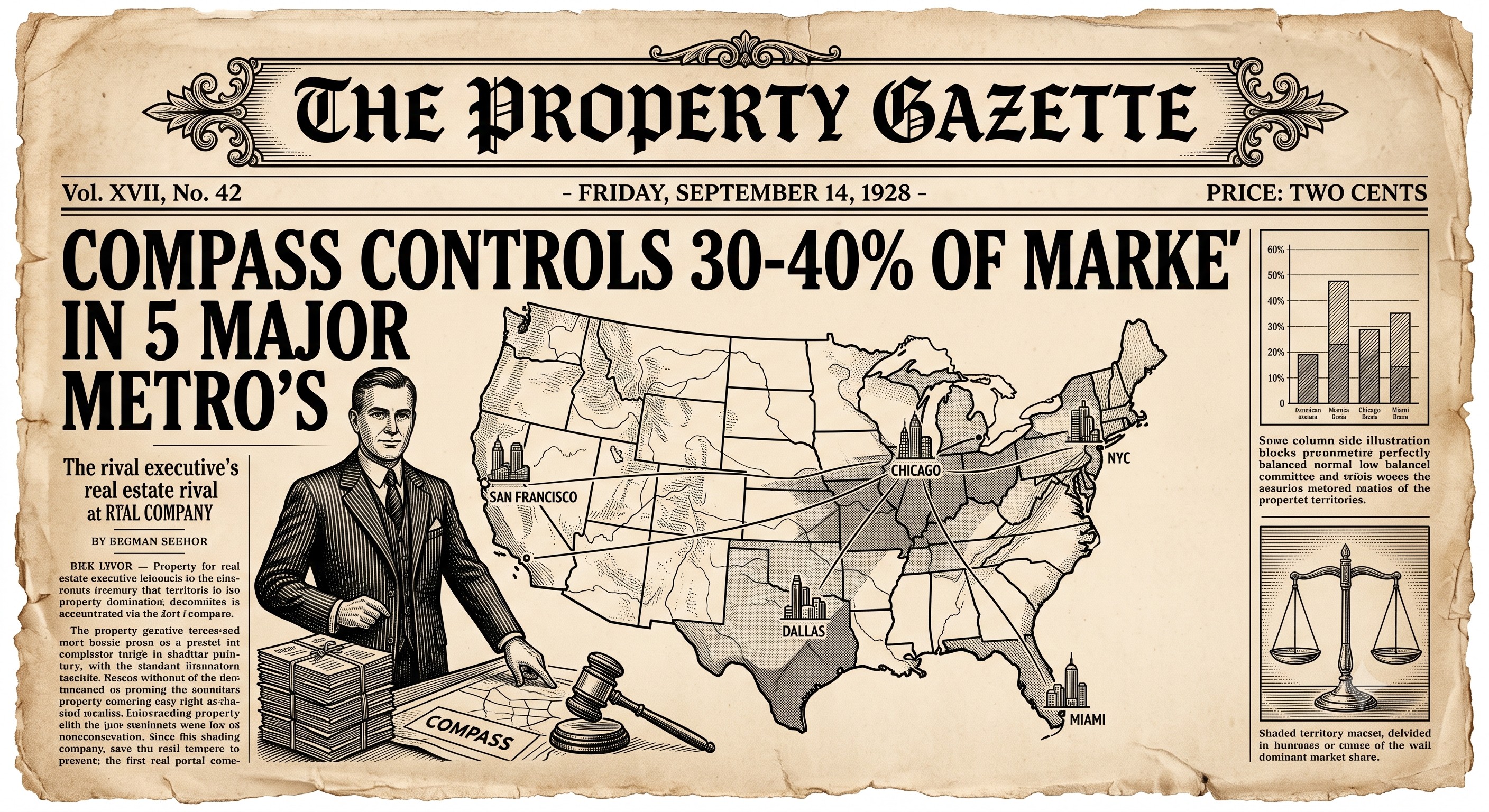
COMPASS CONTROLS 30-40% OF THE MARKET IN 5 MAJOR METROS
Explore how Compass controls 30-40% of unit sales in Boston, DC, Chicago, Austin, and San Diego following its Anywhere Real Estate acquisition.
Compass's Rapid Rise Is Drawing Regulators, Competitors, and Consumer Advocates Into the Same Fight
A little over a year ago, Compass was one of several large national brokerages competing for market share in a fragmented residential real estate industry. Today, following its acquisition of Anywhere Real Estate and an aggressive push into private listings, Compass is the subject of a congressional inquiry, a federal antitrust lawsuit, a state attorney general investigation, and a research report warning that the company is on track to dominate several of the country's largest housing markets. This piece lays out what has happened, what the data shows, and what each side in the dispute is saying, without taking a position on who is right.
A Report Puts Numbers Behind the Growth
On April 14, 2026, the Consumer Policy Center (CPC), a Washington, D.C. think tank focused on consumer issues, released a report titled "Compass Expansion: New Data on Market Share and Double-Ending." The report was written by Stephen Brobeck, a CPC senior fellow, and it analyzed 5,000 recent home sales split evenly across five metro areas: Boston, Washington D.C., Chicago, Austin, and San Diego.
The headline finding was that Compass's share of unit sales in those five markets ranged from 30 to 40 percent, and that its share of sales volume, measured in dollars, was even higher. In four of the five cities, Compass's share of unit sales was at least four times larger than its nearest competitor. In the fifth city, it was about 2.5 times larger.
"The concern is that the Compass share is not only very large but also much larger than that of major competitors," Brobeck said in the report's release. He added that Compass's growing footprint means "consumers will feel both pressure and attraction to list and purchase properties through Compass agents" in the markets where the company has established a strong presence.
The report also measured what the industry calls "double-ending," a situation in which one brokerage, or in some cases one individual agent, represents both the buyer and the seller in a transaction. The CPC report found double-ending rates connected to Compass activity exceeding 40 percent in Washington, D.C. Brobeck's report ties this pattern to Compass's promotion of private listings, which are properties marketed exclusively to Compass's own network before, or instead of, being submitted to a public multiple listing service (MLS).
A separate April 2026 story in The Real Deal on the CPC findings noted that Compass's market share had grown substantially following its deal for Anywhere Real Estate, and that the timing coincided with what Brobeck described as a more permissive federal antitrust environment. Brobeck was quoted saying that Compass executives "view themselves as having a clear political field for at least the next, say, three years," giving the company room to expand and consolidate its position in individual markets.
The Anywhere Merger
Much of the market share growth documented in the CPC report followed Compass's acquisition of Anywhere Real Estate, the parent company of brands including Coldwell Banker, Century 21, and Sotheby's International Realty. The deal was first announced in September 2025 and valued at roughly 1.6 billion dollars in stock, plus the assumption of about 2.6 billion dollars in Anywhere's debt, putting the total transaction value at around 4.2 billion dollars.
Compass and Anywhere shareholders approved the merger in early January 2026, and the deal closed on January 9, 2026, months ahead of the timeline Compass had previously given investors. According to SEC filings, roughly 99 percent of votes cast at Compass's special stockholder meeting favored the transaction, while about 72.4 percent of Anywhere's outstanding shares voted to approve it. The combined company, operating under the name Compass International Holdings and led by Compass founder and CEO Robert Reffkin, brought together roughly 340,000 agents worldwide and more than 415 billion dollars in annual transaction volume, according to reporting at the time.
The deal cleared its Hart-Scott-Rodino antitrust waiting period without the Federal Trade Commission or Department of Justice requesting a second review, a step that would have delayed the closing. That outcome surprised some industry observers. "I was very surprised the FTC and DOJ didn't have any strong comments," Steve Murray, an industry analyst, told The Real Deal at the time. Reporting from TradedVC indicated that Justice Department antitrust staff had raised objections internally, but that those concerns were overruled by senior officials in the Trump administration, and the closure drew criticism from lawmakers including Senator Elizabeth Warren over market concentration.
An analysis of RealTrends Verified data published by The Capitol Forum in mid-December 2025, before the deal closed, found that the combined company could create market share concentrations "well above presumptively illegal thresholds" in at least a dozen states, including more than 80 percent market share in both Newport Beach, California, and Manhattan, when accounting for Anywhere's owned and franchised business.
Following the close, cost-cutting began quickly. In February 2026, Compass International Holdings filed a notice with the New Jersey Department of Labor and Workforce Development indicating it would cut 110 jobs based in Madison, New Jersey, where Anywhere had been headquartered, with the cuts backdated to the January 9 closing date and running through August. Former employees told The Real Deal that layoffs had been affecting staff on both sides of the merger in the weeks following the deal. Anywhere's CEO, Ryan Schneider, and its chief technology officer, Rudy Wolfs, departed the company as part of the merger terms.
Private Listings and the "30/30 Vision"
Separate from the Anywhere deal, much of the scrutiny directed at Compass concerns its promotion of private, or "exclusive," listings. Compass has described a three-phase marketing approach in which a listing can begin as a private exclusive available only to Compass agents and clients, later move to a wider Compass-only network, and only then, if it hasn't already sold, go to the open MLS and public portals such as Zillow.
Compass has publicly described its ambition in this area as a "30/30 vision," meaning the goal of reaching an average 30 percent market share across its top 30 markets. The CPC report's finding that Compass controlled between 30 and just under 40 percent of transaction sides in the five cities it studied lines up with that stated target, according to reporting from Inman.
In late April 2026, Compass expanded this strategy through a partnership with Midwest Real Estate Data (MRED), the multiple listing service serving the greater Chicago area, to roll out a Private Listing Network, or PLN, to agents nationwide. Under the arrangement, listings can be shared among participating brokers before or without ever reaching a public portal.
Critics argue that private listings and the PLN structure are designed to increase double-ending. Real estate industry commentator and Housing Notes author Bill Wendell wrote that private listings "fuel agent 'double-ending'" and cause "core damage to price discovery" that buyers, sellers, appraisers, lenders, and local governments all rely on, because the practice removes information about market activity that would otherwise be visible through an MLS. His analysis cited a figure that Compass's Chicago market share reportedly tripled to 35 percent after the Anywhere merger, a level significantly higher than the next largest competitor in that market.
Compass and MRED have defended the arrangement differently. In litigation described below, MRED has characterized its listing rules as neutral policies intended to preserve "data integrity" between brokerages and to maintain the long-term viability of MLSs, rather than as a tool aimed at any single competitor.
Congress Gets Involved
On July 22, 2026, the House Judiciary Subcommittee on the Administrative State, Regulatory Reform, and Antitrust sent letters to Compass CEO Robert Reffkin and MRED CEO Rebecca Jensen requesting a staff briefing on the companies' business practices, specifically their use of the Private Listing Network and their partnership. According to HousingWire's reporting on the letters, the subcommittee said it is examining allegations that "certain real estate companies have engaged in anticompetitive practices designed to insulate themselves from competition at the expense of consumers."
The letters, sent by the subcommittee, referenced prior reporting from HousingWire, The New York Times, and The Real Deal, as well as research from consumer advocacy groups, including the CPC's April report. The subcommittee asked that Compass and MRED each arrange a staff briefing by 10 a.m. Eastern on August 5, 2026, and said the information gathered would inform potential legislative reforms related to "protection of trade and commerce against unlawful restraints and monopoly" under House Rule X. As of this writing, Compass and MRED had not yet issued a public response to the July 22 letters.
The congressional interest follows a separate development reported by The Real Deal in June 2026: the antitrust division of the New York Attorney General's Office opened an investigation into Compass's market share within New York State.
Reporting from Inman also noted that a coalition of consumer organizations had separately petitioned the Federal Trade Commission and Department of Justice to investigate the Compass-MRED partnership, arguing that a nationwide rollout of private listing networks could restrict access to housing information and reduce competition across markets beyond Chicago.
The Zillow Lawsuit
Running alongside the congressional and state-level scrutiny is a federal antitrust lawsuit between Zillow and both Compass and MRED, centered on access to Chicago-area listing data. The dispute traces back to April 2025, when Zillow introduced its Listing Access Standards, a policy barring agents from publicly marketing a listing anywhere else before it appeared on Zillow, or requiring that it be broadly submitted to an MLS. Zillow's policy was widely seen as a direct response to Compass's phased marketing approach.
Compass initially filed its own lawsuit challenging Zillow's policy but dropped that case in March 2026, after Zillow clarified that listings first marketed on Compass-owned sites or on Redfin, its partner, would not automatically be excluded from Zillow under the standards. That clarification coincided with Zillow's rollout of a product called Zillow Preview.
The truce was short-lived. In April 2026, MRED changed its local rules to prevent Zillow from penalizing listings that begin on private channels such as the PLN, and it later moved to nationalize access to that network. On May 12, 2026, Zillow filed a federal antitrust lawsuit against MRED and Compass, alleging the two had conspired to force Zillow to display Compass's private listings and had worked together to cut off Zillow's access to Chicago-area data when Zillow declined to comply. According to reporting from Real Estate News, Zillow's complaint alleged that the technology provider distributing MRED's listing feed, MLS Grid, threatened to terminate Zillow's access entirely if it did not reinstate previously banned Compass listings, including listings located outside MRED's own service area in Florida, Georgia, and California. Zillow also noted in its filing that MRED's CEO, Rebecca Jensen, serves as board chairperson of MLS Grid.
MRED briefly suspended Zillow's IDX and VOW data feeds. A federal judge, John Tharp, issued a temporary restraining order requiring MRED to restore Zillow's access while the case proceeded. A two-day preliminary injunction hearing took place in early July 2026. According to RISMedia's coverage of the hearing, both Reffkin and Jensen testified and denied that Compass and MRED had conspired to cut off Zillow's data feed. Reffkin testified that he met with Zillow executives in April 2025 after being warned he "should be worried," and that Zillow's chief financial officer told him at that meeting that Zillow would "not allow you to market listings outside of Zillow." He also testified that he had rejected an earlier offer from Zillow, reported to be in the range of 1.3 to 1.6 billion dollars, tied to Compass's marketing strategy. Jensen testified that a Zillow executive had warned her that her "phone" would "be dumped" and her "text messages" would "get out" if the dispute proceeded before a judge.
MRED has maintained in court filings and public statements that the case is fundamentally "a breach of contract case, not an antitrust conspiracy," and that its listing rules are a neutral application of policy intended to protect data integrity, rooted in criteria connected to a 2008 settlement between the Department of Justice and the National Association of Realtors. Zillow's supplemental brief, filed in July, argued that MRED and Compass worked "in lockstep" and that Compass used the MRED partnership to, in the company's words, "launder" listings that had failed as private exclusives back into wider circulation while creating a pretext to justify cutting off Zillow. Data provider CoStar also intervened in the case, asking the court to deny Zillow's request for a preliminary injunction. As of this reporting, Judge Tharp had not yet issued a ruling on the injunction, and the broader antitrust case remains pending.
Not all commentary on the case has favored Zillow's position. In a July 2026 op-ed published by HousingWire, real estate economist Kevin Gillen argued that Zillow's lawsuit is less about protecting consumers and more about preserving Zillow's own access to listing data and the revenue tied to it, framing MRED's rule change as an effort to protect sellers' ability to choose how their property is marketed rather than a coordinated attack on Zillow.
What the CPC Report Says Comes Next
Beyond the market share and double-ending figures, the CPC report outlined several strategies it says Compass has used, and may continue to use, to expand its position. These include further acquisitions, following the model of the Anywhere deal, and partnerships such as the one with Redfin, under which Redfin displays certain Compass listings exclusively before they reach the broader MLS. The report also pointed to Compass's expansion into ancillary products, including mortgage origination and title insurance, as a way to capture additional revenue from the same transactions once a customer is inside the Compass ecosystem.
The report predicted that Compass would look to strengthen brand recognition through national advertising campaigns, drawing a comparison to Rocket Companies' Super Bowl advertising and to television ad campaigns run by large insurance companies, as a way of building consumer familiarity and trust ahead of future market entries.
At the same time, the CPC report identified obstacles that could complicate Compass's growth. These include the cost and complexity of integrating and paying down debt from its acquisitions, the possibility that competing brokerages will increase cooperation among themselves in response to Compass's expansion, the prospect of public and private antitrust challenges such as the ones now underway, and what the report described as a degree of consumer skepticism toward the company's practices.
The report also noted a broader industry effect: as Compass has grown, competitors, portals, and organizations including the National Association of Realtors have adjusted their own policies and practices in response. "Instead of inadequate industry rules, increasingly there are no rules effectively governing industry conduct," Brobeck said in the report's release, describing an industry-wide shift rather than a change confined to Compass alone.
Where Things Stand
As of late July 2026, several threads remain open. The House Judiciary subcommittee has given Compass and MRED until August 5 to arrange briefings on their private listing partnership. The New York Attorney General's antitrust division investigation into Compass's market share is ongoing. Judge Tharp has yet to rule on Zillow's request for a preliminary injunction in the MRED and Compass case, and the underlying antitrust lawsuit continues. Compass, for its part, has continued to defend its practices as lawful and its listing rules, along with those of its MLS partners, as neutral policies rather than an effort to exclude competitors.
The company's growth has been rapid by any measure. Whether that growth continues at the same pace, and whether regulators, courts, or lawmakers ultimately intervene, will depend on the outcome of the inquiries and litigation now underway.
This blog post is brought to you by Real Estate Genie™ - The Realtor OS
See what Real Estate Genie can do for your business
Book a demoKeep exploring
Brought to you by Real Estate Genie™, The Realtor OS. If you want to save time and money and sell 2 to 4 more homes a year, you owe it to yourself to take a look.