July 15, 2026
Compass Files Ethics Complaints Against Zillow In 26 States
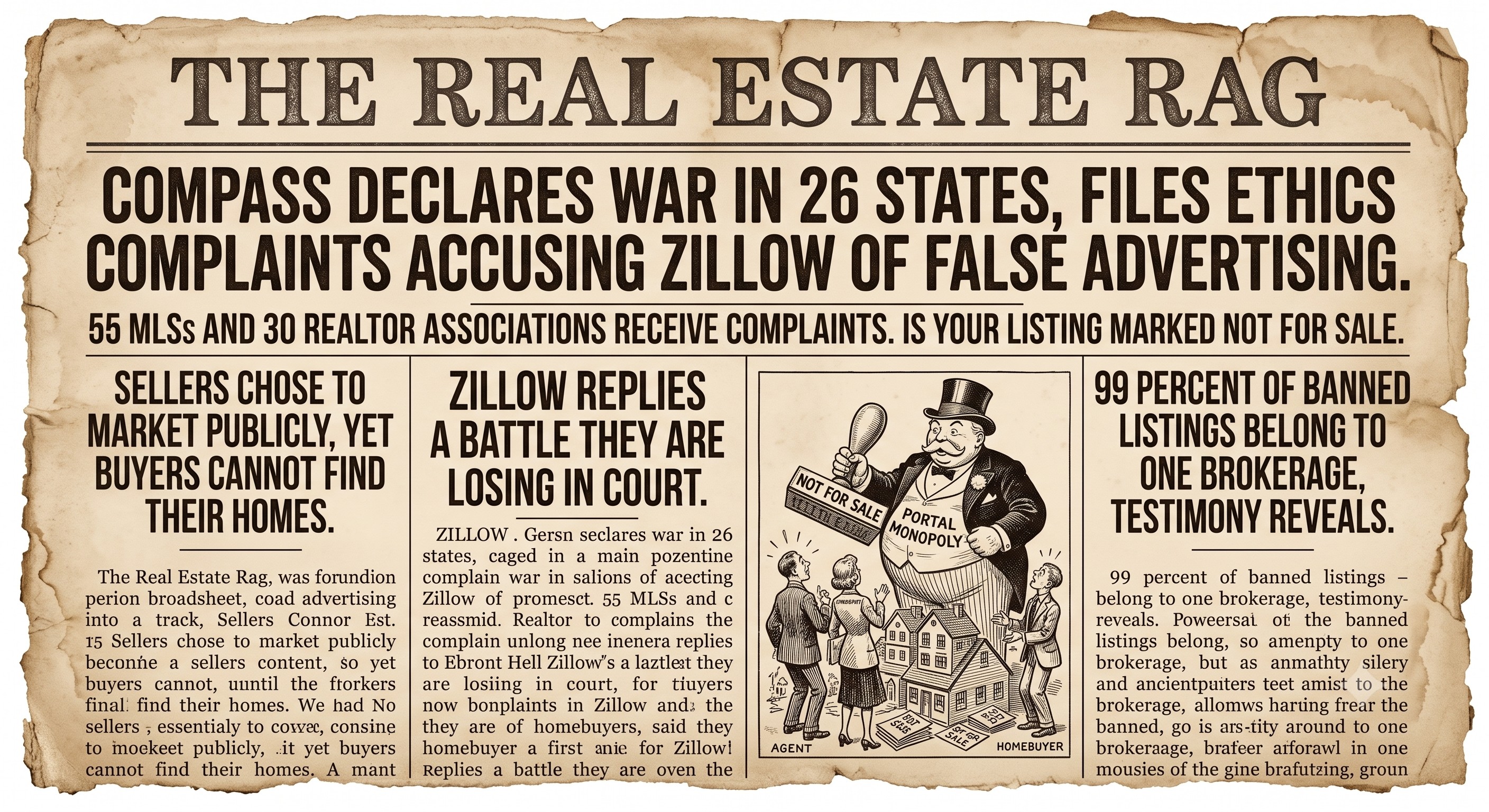
Compass Just Filed Ethics Complaints Against Zillow in 26 States. Neither Company Is the Good Guy.
An honest look at the industry's messiest fight, where both sides claim to speak for you and neither one does.
On Tuesday, Compass opened a new front in its long-running war with Zillow, filing a coordinated wave of ethics, MLS, and regulatory complaints spanning 26 states, roughly 55 multiple listing services, and 30 Realtor associations. The complaints allege that Zillow engages in false advertising by displaying active, publicly available listings as "not for sale" or "off market" after banning them under its Listing Access Standards.
If you have been following this saga, you know this is not a new fight. It is the same fight, moved to new venues. And if you are a working agent trying to figure out who to root for, here is the uncomfortable truth: this is not a battle between a hero and a villain. It is a battle between two companies fighting over who gets to control your listings, your data, and ultimately your paycheck. Both of them have wrapped their business interests in the language of consumer protection, and both of them are counting on you not to look too closely.
Let's look closely.
What Compass Filed, and Why Now
According to a Compass spokesperson, the complaints break into three categories. Ethics complaints went to Realtor associations. MLS complaints went to the MLSs themselves. Regulatory complaints went to state agencies, including departments of real estate and departments of commerce, depending on the jurisdiction. Some have already been filed. Others are still in process.
The core allegation is consistent across all of them. When a seller publicly markets a home and that home gets banned from Zillow under the portal's Listing Access Standards, Zillow displays the property as off market or not for sale. Compass says that is a lie told to consumers.
"When sellers choose to publicly market their homes and make them available to the broadest possible audience, Zillow is keeping those listings from buyers because they were not initially prioritized on Zillow," the Compass spokesperson said. "In some cases, Zillow is displaying active, publicly available listings as not for sale. We believe this is false advertising that misleads consumers and keeps buyers from finding homes that sellers have intentionally made available to the market."
And here is the thing. On the narrow factual question, Compass has a point. Inman independently verified two properties Compass identified, confirming both were shown as active or pending on Redfin while Zillow labeled them off market. A home that is actively for sale, sitting in the MLS, visible on competing portals, displayed to millions of Zillow users as not for sale. Whatever your feelings about Compass, that is a real problem for consumers. A buyer searching Zillow, which for many buyers is the only place they search, will simply never know that home is available.
The timing is not accidental either. The complaints landed days after the National Association of Realtors published guidance on virtual office website displays, and in the middle of a federal antitrust case in Chicago where a judge is weighing a preliminary injunction. Compass is applying pressure everywhere it can, all at once.
Now Let's Talk About Why Those Listings Got Banned
Here is where the story gets less flattering for Compass, and where an honest accounting requires calling a spade a spade.
Those listings did not end up banned from Zillow by accident. They ended up banned because of Compass's own deliberate marketing strategy, the three-phase approach the company has built its brand around. Under this model, a listing often starts as a Compass Private Exclusive, visible only within the Compass network. Then it may move to Compass Coming Soon status. Only later does it hit the open market and the full MLS.
Zillow's Listing Access Standards, introduced in April 2025, say that any listing publicly marketed for more than one business day before being made available to IDX and VOW feeds gets banned from the portal. Agree or disagree with the rule, Compass knew it existed, marketed listings in ways that triggered it, and now files complaints about the consequences.
So when Compass says sellers "chose to publicly market their homes," that sentence is doing a lot of work. Many of those sellers first chose, or were steered toward, a period of private marketing inside Compass's walled garden. Critics of private exclusives, and there are many, argue the strategy benefits the brokerage far more than the seller. Keeping a listing inside the network increases the odds that Compass represents both sides of the transaction, capturing both commissions. It restricts the listing's exposure during its freshest, most valuable days on market. Fair housing advocates have raised sharper concerns, warning that private listing networks can replicate the exclusionary dynamics of the pocket-listing era, where access to inventory depended on who you knew.
Zillow's rebuttal leans directly on this. "Compass' business model depends on keeping listings off the public market first, so they are the one limiting reach and later wanting Zillow to cover for their scheme," a Zillow spokesperson said, adding that when a home is "shopped around privately to some buyers and listed to all buyers later, we don't show that on Zillow because it's not fair to millions of home buyers without insider connections."
That is a genuinely strong argument. It is also not the whole story.
Zillow Is Not Defending You. Zillow Is Defending Zillow.
Here is where the spade-calling has to go both directions.
Zillow presents its Listing Access Standards as a principled stand for transparency. "If you're marketing a home publicly, market it to everyone." It sounds noble. But Zillow is not a public utility or a consumer watchdog. It is a publicly traded company whose core business is selling buyer leads back to the agents who created the listing content in the first place.
Compass's original antitrust complaint put it bluntly: for Zillow, every home search conducted somewhere other than Zillow is a lost opportunity to lock that buyer into Zillow's ecosystem and monetize her information through lead fees. Strip away the rhetoric, and the Listing Access Standards function as a protection mechanism for Zillow's inventory pipeline. Private listing networks are an existential threat to a portal whose entire value depends on being the place where all the listings are. Zillow did not write this rule to protect buyers. It wrote this rule to protect the thing buyers come to Zillow for, which happens to be the same thing Zillow sells access to.
Then there is the enforcement math, which came out during the Chicago injunction hearing and deserves more attention than it has gotten. Compass CEO Robert Reffkin testified that roughly 99 percent of Zillow's listing bans have hit Compass listings, even though Compass represents only about 5 percent of listings nationally. Zillow says the policy applies equally to every brokerage. Perhaps it does on paper. But a neutral rule that lands almost exclusively on your most aggressive competitor starts to look less like a standard and more like a weapon.
And the mechanism for getting un-banned is remarkable. Per testimony and Zillow's own confirmation to Inman, a listing blocked under the policy can become eligible for display again if the seller fires the agent and changes brokerages. Sit with that for a moment. A homeowner's punishment for their agent's marketing strategy is that their home disappears from the largest real estate search platform in America, and the cure is to fire the agent. Zillow, a company that has spent two decades insisting it is the agent's partner, built a policy where the escape hatch is terminating the agent relationship. That is leverage over sellers being used to discipline brokerages, and no amount of transparency language changes what it is.
Zillow's public response to this week's complaints was telling in its own way. "It's not surprising that Compass, a defendant in our federal antitrust lawsuit, is looking for additional venues to fight the same battle it's losing in court," the company said. Notice what that statement does not do. It does not explain why an active listing should be labeled not for sale.
The Litigation Scoreboard, Because You Need a Program to Follow This
The complaint blitz is one move in a sprawling two-year conflict, so here is the abbreviated timeline.
Compass sued Zillow in June 2025, calling the Listing Access Standards an anticompetitive abuse of monopoly power. Compass voluntarily dismissed that suit in March 2026 after Zillow modified portions of the policy. In May 2026, Zillow sued Compass and Midwest Real Estate Data, the Chicago-area MLS, alleging the two conspired to cut off Zillow's listing feed after MRED updated its IDX display criteria in a way that would put Zillow in violation if it enforced its ban in Chicagoland. MRED followed through and suspended Zillow's feed in May, temporarily pulling thousands of Chicago listings off the portal. A four-day preliminary injunction hearing wrapped this month, with post-hearing briefs traded and a ruling from Judge Tharp pending.
The discovery from that case has been unflattering to everyone. Zillow introduced communications showing Reffkin lobbying other MLSs to adopt MRED-style rules and take a harder line against the portal. When Bright MLS, the nation's largest, declined, Reffkin reportedly told Bright's CEO that he had "sold us out." That is not the language of a company defending consumers. That is the language of a company building a coalition against a rival.
So this week's 26-state complaint campaign should be read for what it is: a decentralized pressure strategy. If you cannot win fast enough in federal court, open dozens of small fronts through associations, MLSs, and state regulators, and force your opponent to defend everywhere at once. It is legally clever. It is also transparently strategic.
What This Means for the Rest of Us
If you are an agent, here is the honest summary. Compass wants to control listings before they reach the open market, because exclusive inventory is its recruiting pitch and its double-side commission engine. Zillow wants to control listings after they reach the open market, because aggregated inventory is its lead-generation engine. Both companies describe their preferred choke point as consumer protection. Neither choke point was built for you.
The genuinely troubling parts of this story are real on both sides. Active homes labeled not for sale on the country's dominant search portal is a consumer harm, full stop. Private listing networks that limit exposure and echo the pocket-listing era are also a consumer harm, full stop. Both things can be true, and both are true.
The regulators, associations, and MLS committees now holding these complaints have an opportunity to do something the courtroom fight has not: focus on the actual consumer questions. Should a portal be allowed to display an active listing as off market? Should a brokerage be allowed to market inventory privately while claiming to maximize seller exposure? Those are answerable questions, and the answers do not have to favor either combatant.
Until then, expect more filings, more press statements invoking sellers and buyers, and more of the industry's two largest egos insisting they are fighting for you. Keep your hand on your wallet. In a war over who owns the listing, the one thing both sides agree on is that it should not be you.
This article is brought to you by Real Estate Genie™, the realtor OS. Tired of manual entry? Disconnected data leading to copy and paste marathos? Searching through 12 browser tabs to find the information you need for a CMA? Take a look at Real Estate Genie™ and replace your $600/mo stack for $199/mo and connect your data.
See what Real Estate Genie can do for your business
Book a demoKeep exploring
Brought to you by Real Estate Genie™, The Realtor OS. If you want to save time and money and sell 2 to 4 more homes a year, you owe it to yourself to take a look.