July 23, 2026
Congress Just Asked Real Estate to Explain Itself: What the Compass and MRED Summons Means for Every Agent
"A House subcommittee just summoned Compass and MRED over private listings. Here is why every working agent should be paying attention."
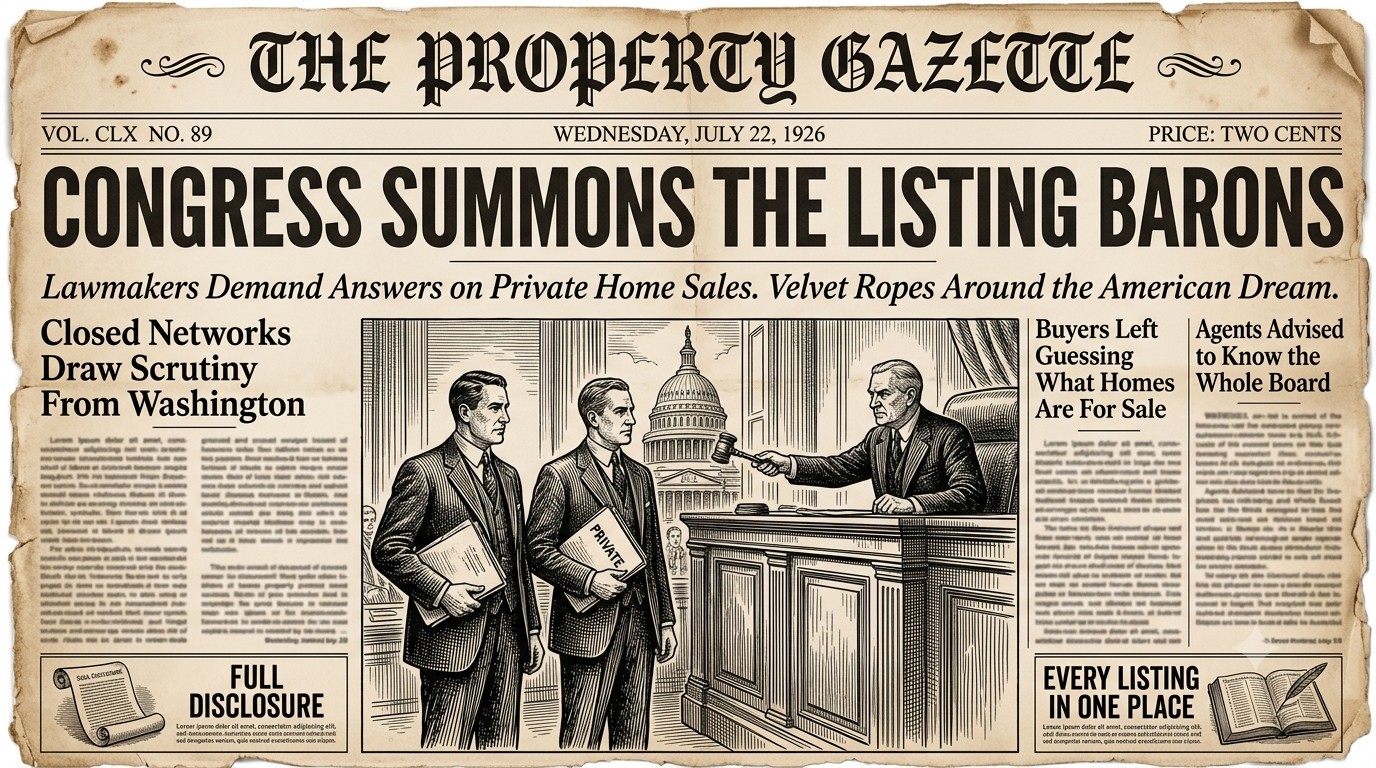
Congress Just Asked Real Estate to Explain Itself: What the Compass and MRED Summons Means for Every Agent
The private listing fight has officially left the industry trade press and landed on Capitol Hill.
On July 22, 2026, the House Judiciary Committee's Subcommittee on the Administrative State, Regulatory Reform, and Antitrust sent letters to Compass CEO Robert Reffkin and Midwest Real Estate Data (MRED) CEO Rebecca Jensen, summoning both executives to brief the subcommittee on their companies' private listings partnership. The letters, first reported by Real Estate News and separately obtained and verified by HousingWire, ask both CEOs to schedule briefings as soon as possible and no later than August 5, 2026.
Read that timeline again. Two weeks. When Congress gives you a two-week window, it is not a casual request for coffee.
For most working agents, a Congressional subcommittee letter feels like something happening far above your pay grade. It is not. The questions this subcommittee is asking go straight to the heart of how you win listings, how your buyers find inventory, and whether the MLS you pay dues to will still function as a shared marketplace five years from now. Let me walk you through what happened, how we got here, and what it actually means for your business.
What the Subcommittee Letters Say
The subcommittee, chaired by Representative Scott Fitzgerald, a Republican from Wisconsin, sent identical letters to Reffkin and Jensen as part of a broader review of antitrust enforcement. According to HousingWire's reporting on the letters, the panel is examining whether certain real estate companies are using private listing networks and similar structures to insulate themselves from competition at the expense of consumers.
The letters raise three specific concerns worth understanding in plain terms.
First, the closed information system problem. Fitzgerald wrote that the Compass and MRED partnership would create a closed information system for certain real estate listings, and that this raised concerns about what information will be available to consumers and the potential effect on housing affordability. Translation: if a meaningful share of homes for sale only appears inside a members-only network, buyers who are not plugged into that network are shopping from an incomplete menu, and nobody can be confident the market price is the real price.
Second, the dual agency incentive. The subcommittee argued that arrangements like this one incentivize brokers to push sellers into private listings, which increases the odds of dual agency transactions where one agent or one brokerage sits on both sides of the deal. The letters said dual agency deals can create conflicts of interest by limiting a buyer's access to independent representation. When a buyer has to call the listing agent to even learn a home exists, the listing agent controls the entire transaction funnel.
Third, the fragmentation problem. The subcommittee warned that private listing networks could fragment inventory, weaken price competition, and create what the letter memorably called "velvet ropes" around certain properties. Fewer eyes on a listing means fewer competing offers. Fewer competing offers means less price discovery. And in a market where the national median existing home price hit a record $440,600 in June according to the National Association of Realtors, anything that muddies price discovery lands hardest on the buyers who can least afford a mistake.
MRED, for its part, confirmed receipt and responded publicly with confidence. A spokesperson told Real Estate News the MLS looks forward to responding and helping the committee understand its business practices. Compass did not immediately respond to requests for comment on the story.
How We Got Here: The April Partnership
To understand why Congress is paying attention, you need to rewind to April 24, 2026. That is the day MRED, the Chicago-based MLS and one of the largest in the country, announced it was opening its entire MLS service, including its Private Listing Network, to any licensed agent in the United States.
This was not a small regional policy tweak. MRED has operated its Private Listing Network in the Chicago area for roughly a decade, and it has defended that network consistently, even under industry pressure. The April announcement took a local framework national.
Compass was the first, and so far the only, brokerage to sign on at scale. Under the arrangement, Compass committed to feeding its nationwide inventory, including its Private Exclusive and Coming Soon listings, into MRED's network. Compass also committed to subsidizing part of the MRED membership cost for the first 100,000 Compass agents who join as full members.
Think about that number for a second. One hundred thousand subsidized memberships is not a pilot program. It is an infrastructure play. It converts a Chicago MLS into a national distribution channel for pre-market inventory, anchored by the largest brokerage in the country.
Both CEOs framed the move as consumer empowerment. Reffkin said in the announcement that "giving homeowners choice in marketing their listings is the right thing to do." Jensen, in a statement reported by The Real Deal, positioned the MLS as a facilitator of cooperation rather than a dictator of marketing practices, noting MRED has offered sellers options through its private network for a decade.
MRED also built in some notable protections. According to the announcement, listing filtering must be based on objective criteria rather than which brokerage represents a listing, and MRED committed to protecting agents who participate in its Private Listing Network from being banned or penalized by third-party portals and IDX feed recipients.
That last clause was not written in a vacuum. It was written with one specific portal in mind.
The Zillow War Running in Parallel
The subcommittee letters did not appear out of thin air. They landed in the middle of an active federal antitrust lawsuit between Zillow on one side and Compass and MRED on the other.
Here is the short version of a long fight. Zillow implemented listing access standards requiring that listings marketed publicly be made widely available, a direct shot at pre-marketing programs like Compass's Private Exclusives. Compass sued Zillow over those standards, then dropped that suit in March 2026, as RISMedia reported. The conflict then flipped. In May 2026, MRED temporarily cut off Zillow's listing feed, and Zillow responded with its own antitrust lawsuit against MRED and Compass. By early July, a federal judge in Chicago was hearing witness testimony from Zillow, MRED, Compass, and other industry players in a preliminary injunction hearing over whether MRED can be blocked from cutting Zillow's feeds.
So when the House subcommittee sent its letters on July 22, it was not opening a new front. It was joining a battlefield that already had lawyers on it.
The Pressure Campaign That Preceded Congress
Congressional interest rarely materializes without groundwork, and this case is no exception. Two prior pressure points set the table.
The first came in December 2025. Before Compass finalized its $1.6 billion acquisition of Anywhere, the parent of brands like Coldwell Banker, Century 21, and Sotheby's International Realty, Democratic Senators Elizabeth Warren of Massachusetts and Ron Wyden of Oregon wrote to the Department of Justice and the Federal Trade Commission asking them to closely scrutinize the deal, calling its antitrust implications significant, as Real Estate News reported at the time. The acquisition closed anyway, and that consolidation is exactly what makes the private listing question so much bigger now. A private network attached to a mid-sized brokerage is a niche product. A private network attached to a post-Anywhere Compass is a parallel market.
The second pressure point came on July 1, 2026. A coalition led by the Consumer Federation of America, joined by groups including the American Economic Liberties Project, the National Consumer Law Center, Consumer Action, and the Woodstock Institute, sent a public letter to FTC Chair Andrew Ferguson and the DOJ urging a federal investigation into Compass's agreements with multiple MLSs. The CFA letter named not just MRED but also Bright MLS, Tennessee-based Realtracs, and Southern California's The MLS/CLAW, arguing the deals were designed to expand off-market listing networks that bypass traditional public distribution.
The coalition's argument was blunt. They wrote that regulators should investigate whether the agreements amount to an unlawful effort to reduce transparency and fair competition, and the letter closed with a line built for headlines: "One company should not be able to monopolize access to the American Dream."
The civil rights framing matters here too. The CFA and allied groups cited research indicating that homes sold off the open market tend to sell for less, with the harm falling disproportionately on communities of color. Whatever you think of private listings as a business strategy, that is the argument regulators and legislators will weigh, because fair housing law does not care about your marketing plan.
Three weeks after that letter, the subcommittee summons arrived. Connect the dots.
The Other Side of the Argument
I want to be fair here, because the seller choice argument is not a smokescreen. It is a real position held by serious people, and plenty of agents agree with it.
The case for private listing networks goes like this. Some sellers have legitimate reasons to limit exposure: privacy concerns, security situations, a desire to test pricing before accumulating days on market, or high-profile circumstances where a public listing invites problems. The traditional MLS model, especially under the National Association of Realtors' Clear Cooperation Policy, forces a binary choice: market publicly through the MLS or barely market at all. MRED's model, which does not require any particular marketing approach and offers tools to manage price history and days-on-market data, gives sellers a middle path inside an MLS-governed structure rather than in an informal text thread between agents.
There is also a fairness argument aimed at the portals. Compass and Rocket published a joint open letter earlier this year criticizing MLSs that fine agents over exclusive listing and pre-marketing restrictions. And Compass has put money behind the position before: when Northwest MLS rules in Seattle prohibited pre-marketing, Reffkin told agents Compass would pay any fines they incurred deploying the company's three-phase marketing plan, as Real Estate News has reported.
And note that Compass has diversified its distribution rather than simply hoarding inventory. In February 2026, Compass announced a three-year partnership with Rocket Companies that puts Compass Coming Soon and Private Exclusive listings on Redfin, which Rocket acquired in 2025. You can read that as evidence Compass wants broad exposure for its sellers, or as evidence Compass wants to control which portals get its inventory and on what terms. Both readings are defensible, and that ambiguity is precisely why regulators are asking questions instead of assuming answers.
What This Means for Working Agents
Now the part that matters for your Tuesday morning, not just your industry newsletter reading.
Inventory access is becoming a competitive weapon, and you need to know where you stand. If private networks keep growing, the agents who win will be the ones who can see the most inventory, period. That may mean joining networks you philosophically dislike. It may mean building referral relationships that function as your own early-warning system. Either way, "I only work what's on the MLS" is becoming a smaller and smaller slice of the market in some metros, and pretending otherwise does not serve your buyers.
Your fiduciary duty conversation just got harder, and more valuable. If you represent sellers, you now need a genuinely balanced conversation about public versus private marketing, including the research suggesting off-market sales can underperform on price. If you represent buyers, you need to explain why some homes never hit their portal searches and what you are doing about it. Agents who can walk clients through this landscape clearly will earn trust that no postcard campaign can buy. Agents who cannot will look like they are hiding the ball.
Documentation is about to matter more. If the regulatory temperature keeps rising, expect more disclosure requirements around private marketing choices, more mandatory seller acknowledgment forms, and more scrutiny of dual agency situations. Several states are already moving in this direction. Clean records of what you advised, what the seller chose, and when, are cheap insurance. Sloppy records are a liability with a fuse on it.
Do not assume this resolves quickly or cleanly. The briefings are due by August 5. A Congressional briefing is not a subpoena, a lawsuit, or a rule change. It is information gathering, and it may go nowhere. But it stacks on top of an active federal lawsuit, a DOJ and FTC investigation request from a broad advocacy coalition, and prior Senate scrutiny of the Anywhere deal. That is a lot of independent actors circling the same practice. Industries that draw this pattern of attention usually end up operating under new rules, whether written by regulators, judges, or their own trade groups moving preemptively.
The Question Underneath All of It
Strip away the legal filings and the press statements and one question remains: is a listing a private asset of the brokerage that procured it, or is the shared, transparent marketplace the whole point of organized real estate?
The industry has papered over that question for decades because the MLS answered it by default. Everyone contributed inventory, everyone got access, and cooperation was the price of admission. Private listing networks, national MLS expansion plays, and brokerage-to-portal side deals are all, in different ways, renegotiations of that default.
I built Real Estate Genie around a simple belief: the agents who thrive through industry upheaval are the ones with the best information, organized in one place, available at the moment a client asks a hard question. Whether the future is one big transparent marketplace or a patchwork of velvet-rope networks, the agents who can see the whole board will beat the agents who cannot.
Congress wants answers by August 5. The Chicago courtroom wants them sooner. And your next seller consultation might want them tonight.
So here is my question for you: if a seller asked you tomorrow whether to market their home publicly or place it in a private network, do you have a defensible, documented answer? And would that answer survive a regulator reading it back to you?
This blog post is brought to you by Real Estate Genie™ - Want to learn how you can sell 2-4 more homes per year without investing more time? 👉 Click here
See what Real Estate Genie can do for your business
Book a demoKeep exploring
Brought to you by Real Estate Genie™, The Realtor OS. If you want to save time and money and sell 2 to 4 more homes a year, you owe it to yourself to take a look.