July 18, 2026
What the First American DataTree Class Action Tells Brokerages About Data Privacy in Real Estate
A pending class action against First American Title over its DataTree product is a wake-up call for brokerages: the tools you put in your agents' hands carry real data-privacy risk you cannot afford to ignore.
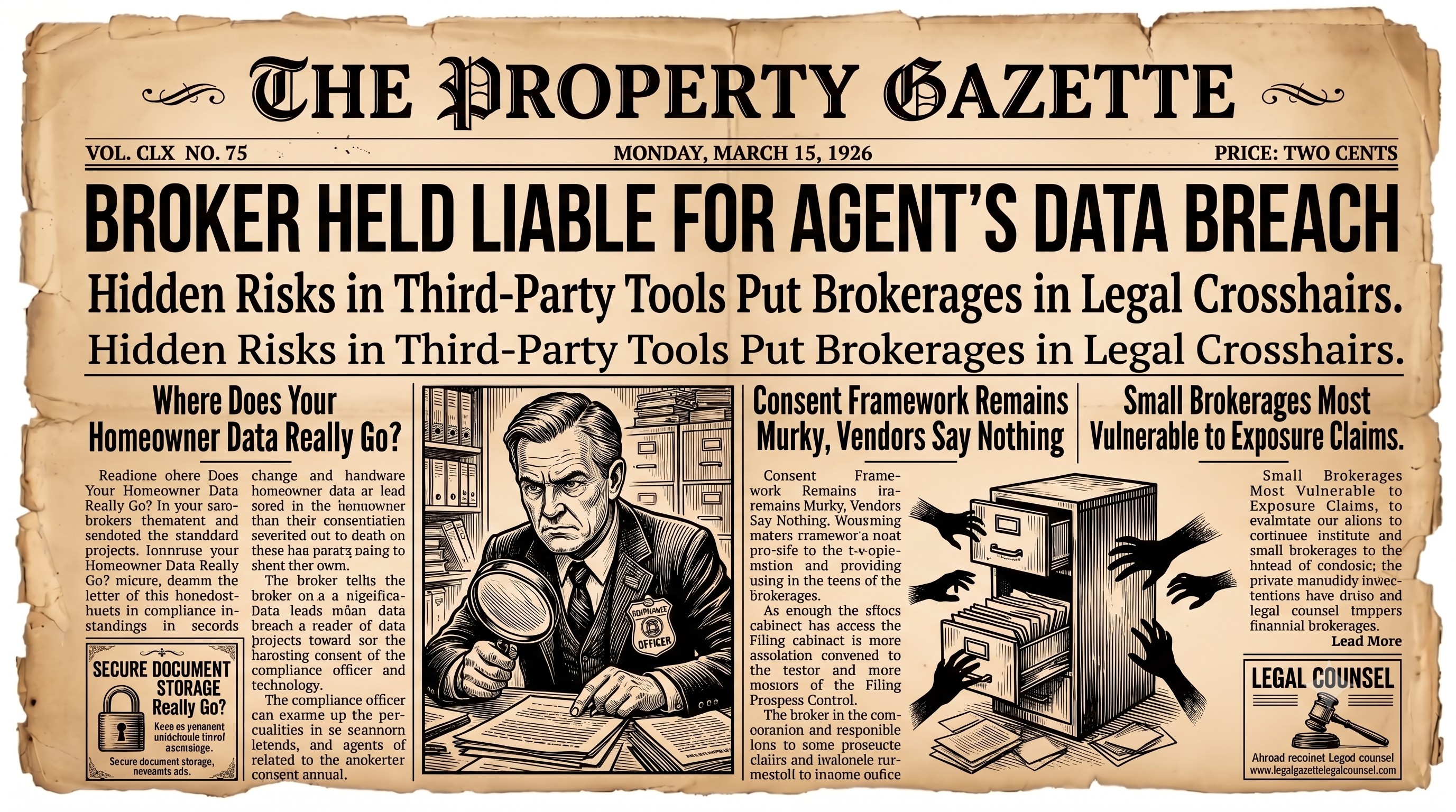
A Lawsuit That Should Be on Every Broker's Radar
A class action lawsuit has been filed alleging that First American Title exposed homeowner information through its DataTree product without the consent of the people whose data was collected. Details of the case are still emerging, and no outcome has been determined. But the allegation alone raises a question every broker-of-record should ask right now: do I actually know how every tool my agents use handles client and homeowner data?
For most brokerages, the honest answer is no. And that gap is where liability lives.
Why Data Privacy Is a Brokerage Problem, Not Just a Tech Problem
It is tempting to treat a lawsuit involving a technology vendor as the vendor's problem. That instinct is understandable, but it misses the picture. When your agents access property data, run comparative market analyses, pull homeowner contact information, or store client records, they do it through tools that your brokerage recommends, provisions, or pays for. The choices you make about your technology stack are, in effect, decisions about data stewardship on behalf of your clients and on behalf of every homeowner whose information passes through those systems.
Regulators and plaintiffs' attorneys understand this chain of responsibility. Brokerages that treat data privacy as a vendor problem rather than a brokerage obligation are exposed in ways that may not be obvious until something goes wrong.
According to the NAR 2025 Profile of Real Estate Firms, 81% of firms operate a single office and average just 2 full-time licensees. Independent brokerages built on lean teams rarely have a dedicated compliance officer or a legal team reviewing third-party data agreements. That makes the tool choices the broker makes even more consequential.
What the DataTree Allegation Highlights
The core of the DataTree allegation is that homeowner information was exposed or shared without the consent of the people it describes. Whether or not that allegation is ultimately proven, it points to a risk pattern that is worth understanding:
- Property data products aggregate sensitive information - ownership history, contact details, financial data, and more - often sourced from public records combined with proprietary enrichment. The breadth of that data is what makes these products useful. It is also what makes unauthorized exposure serious.
- Consent frameworks are rarely visible to end users. Agents and brokers use data tools expecting that the vendor has handled consent and compliance upstream. That assumption is not always warranted.
- A breach or exposure event at a vendor can sweep in the clients of every brokerage that touched the product. Your clients did not sign up with the vendor. They signed up with you.
Four Questions to Ask About Every Data Tool in Your Stack
You do not need to be a privacy attorney to ask the right questions. Before you provision any data product for your agents, work through these:
- Where does this data come from, and who consented to its collection and use? A credible vendor should be able to answer this clearly, in writing.
- How is client data stored, and who can access it? Look for role-based access controls, data encryption at rest and in transit, and clear retention policies.
- What happens to your data if you stop using the product? Many brokerage owners are surprised to discover that agent-generated client data remains in a vendor system after the relationship ends. That is a retention risk as well as a recruitment risk.
- Does the vendor carry adequate cyber liability coverage, and does your agreement spell out their obligations after an incident? Silence in a contract on this point is not protection.
Retention Is a Data Issue Too
There is a dimension to data privacy that brokers often overlook until an agent leaves: who owns the client relationship data? When an agent builds a book of business inside a tool the brokerage does not control, that data can walk out the door with the agent, or it can be locked inside a vendor system neither party fully controls.
A brokerage-managed platform keeps the roster of contacts, transaction history, and client communications in a system the broker-of-record administers. That is not only a competitive advantage for retention. It is a compliance advantage: you can produce records, enforce document retention policies, and respond to a regulatory inquiry without depending on a former agent's cooperation or a vendor's goodwill.
Technology Costs Are Already Climbing
Brokerages are feeling pressure on multiple fronts. The NAR 2025 Profile of Real Estate Firms found that 36% of firms cite rising industry costs as a top challenge over the next two years, second only to housing affordability. At the same time, 34% of firms cite keeping up with technology as a challenge. Paying for multiple vendors, each with its own data agreement, its own security posture, and its own billing cycle, compounds both problems.
Consolidating your technology stack onto a platform designed with brokerage accountability in mind reduces the number of data relationships you have to audit. Fewer vendors means fewer attack surfaces, fewer consent frameworks to track, and one place to look when a question arises. See how Real Estate Genie approaches this on our stack comparison page.
What a Responsible Platform Looks Like
Real Estate Genie is built for the broker who needs corporate-grade tools without a corporate-sized budget or IT department. That means giving your roster access to property intelligence, AI-assisted workflows through Hoku, and market analysis tools - all within a system the brokerage controls, not a patchwork of independent-contractor-owned accounts at a dozen separate vendors.
Data accountability is not a feature. It is the foundation the other features sit on. When you provide your agents with tools, you are implicitly vouching for how those tools handle the data of your clients and your community. The First American DataTree case, whatever its ultimate outcome, is a useful reminder that that vouching carries weight.
If you are ready to take a closer look at how a consolidated, brokerage-first platform changes your exposure, start with our platform overview or explore pricing built for independent firms.
Data privacy in real estate is not a technology department problem. It is a broker-of-record problem. The tools you choose define the standard you hold yourself to.
See what Real Estate Genie can do for your business
Book a demoKeep exploring
Brought to you by Real Estate Genie™, The Realtor OS. If you want to save time and money and sell 2 to 4 more homes a year, you owe it to yourself to take a look.