August 1, 2026
Protect Your Clients and Your License: Red Flags for Deed Theft You Need to Know
Deed theft is a growing threat, especially for seniors and Black homeowners. Here are the red flags every real estate agent should know to protect clients and stay on the right side of the law.
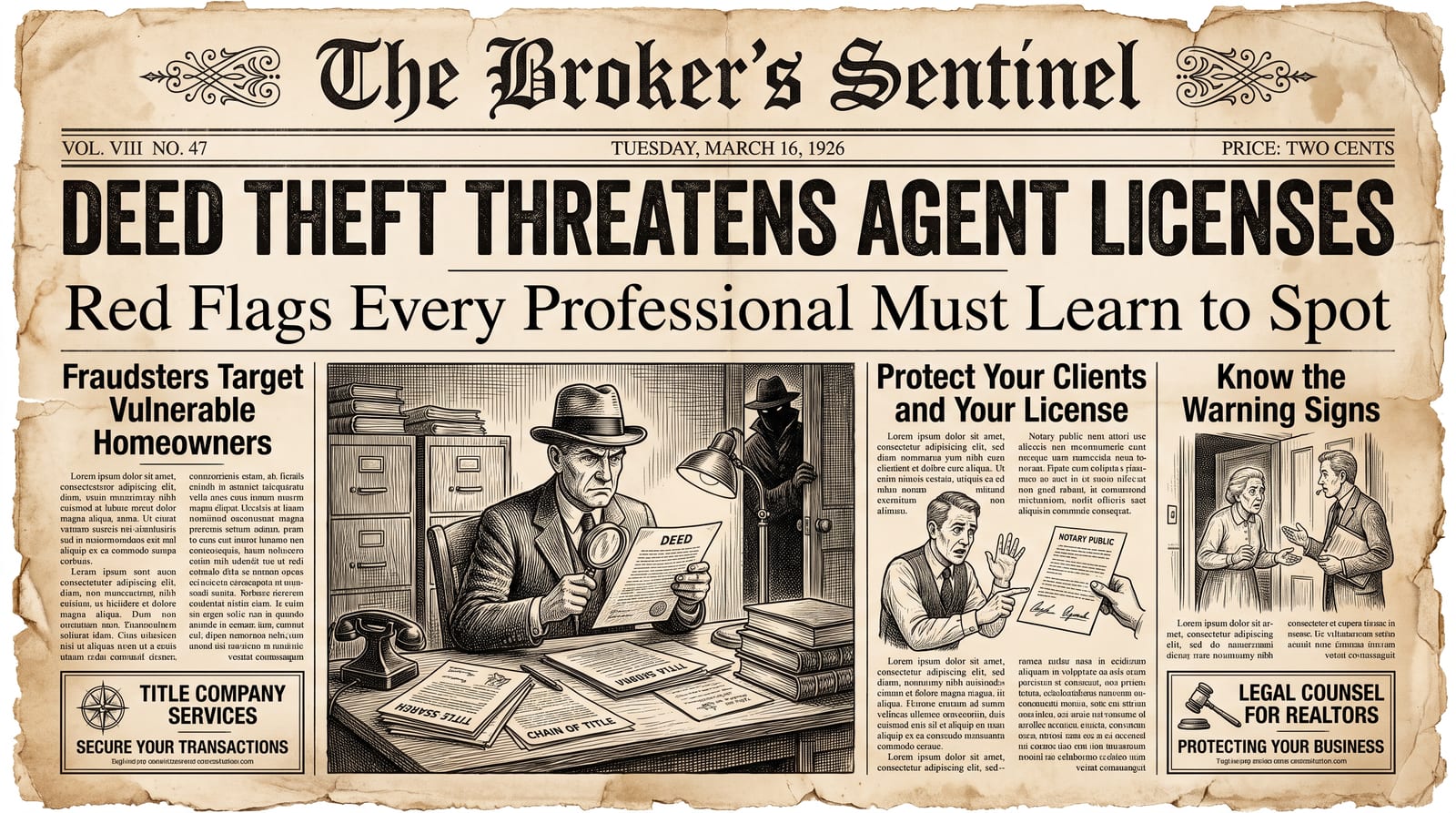
Why Deed Theft Is a Risk Every Agent Must Take Seriously
Real estate fraud does not just hurt homeowners. It can derail a transaction, expose an agent to liability, and shake the trust clients place in you. Deed theft - the illegal transfer of a property title without the true owner's knowledge or consent - is a growing threat, and agents are often in the best position to spot the warning signs before real damage is done.
A New York City attorney who has worked on deed theft cases has identified specific red flags that real estate agents and title agents should watch for. Understanding those signals is part of being a competent, ethical professional in today's market.
Who Is Most Vulnerable
Deed theft does not happen randomly. Fraudsters tend to target homeowners who are less likely to monitor their property records closely or who may be in financial distress. Seniors and Black homeowners are disproportionately at risk, a pattern that has drawn attention from housing advocates and attorneys alike.
As an agent, your job is to serve every client with equal care. Recognizing that certain groups face elevated risk means you should be especially attentive when working with elderly clients or in neighborhoods that have historically faced predatory real estate practices. Fair, vigilant service is both an ethical obligation and a professional one.
Red Flags to Watch For
Whether you are representing a buyer, a seller, or simply doing your due diligence on a property, these warning signs deserve a closer look:
- An unfamiliar party claiming ownership. If someone claims to own a property but cannot produce a clear chain of title or seems evasive about how they acquired it, that is a reason to pause and verify.
- Unusual urgency to close. Fraudsters often push for a fast closing to limit the time anyone has to scrutinize the paperwork. A seller who resists any reasonable request for documentation or insists on skipping standard steps is a red flag.
- A deed that was recently recorded with no corresponding sale. If a title search shows a deed recorded recently but there is no record of a transaction - no listing, no MLS activity, no public record of a sale - that gap deserves explanation.
- Signatures that do not match or seem inconsistent. Notarized documents with signatures that look inconsistent across a file, or notaries who cannot be verified, are worth flagging to a title professional or attorney.
- A property owner who is unaware of the transaction. This sounds obvious, but it happens. If you make contact with a long-time resident and they have no knowledge of any sale or transfer, take that seriously.
- Pressure to use unfamiliar settlement or title services. Fraud rings sometimes steer transactions toward complicit title or settlement companies. If a party is unusually insistent about which service provider to use, ask why.
- Elderly or absent homeowners with a third party doing all the communicating. When someone other than the owner is doing all the talking, signing everything, and controlling the process, verify that the owner is a willing and informed participant.
What to Do When You See a Red Flag
Seeing a warning sign does not mean you accuse anyone of fraud. It means you slow down and ask questions. Here is a practical approach:
- Run a thorough title search early. Do not wait until the closing table to find out there is a problem with the chain of title.
- Speak directly with the homeowner. If there is any doubt about whether the true owner is aware of and consenting to the transaction, find a way to make direct contact.
- Consult a real estate attorney. When something feels wrong, bring in legal counsel. An attorney with experience in real estate fraud can help you assess the situation without putting your license at risk.
- Report suspected fraud. Contact your state's real estate regulatory body, local law enforcement, or a housing counseling agency if you have credible reason to believe a fraud is underway.
Property Intelligence Makes You a Better Gatekeeper
One of the most powerful things an agent can do to protect clients is to walk into every situation as the most-informed person in the room. When you have a complete picture of a property's history - ownership records, transaction activity, and market context - anomalies are much easier to spot.
Real Estate Genie's AI copilot, Hoku, helps you move through research and paperwork faster, so you spend less time on busywork and more time on the things that protect your clients and your reputation. And with built-in valuation and property data tools, you can cross-reference what you are seeing in the field against what the data actually shows - a simple but powerful check.
If you are curious how a single platform can bring these tools together, see what Real Estate Genie does differently.
The Bottom Line
Deed theft is a real and growing harm, and real estate agents are on the front lines of either stopping it or, if they are not careful, inadvertently enabling it. Knowing the red flags, slowing down when something feels off, and using every tool available to verify what you are being told - that is how you protect your clients, your community, and your license.
The best agents are not just deal-closers. They are trusted advisors who catch problems before they become catastrophes.
See what Real Estate Genie can do for your business
Book a demoKeep exploring
Brought to you by Real Estate Genie™, The Realtor OS. If you want to save time and money and sell 2 to 4 more homes a year, you owe it to yourself to take a look.