July 21, 2026
Brokerage Transaction Compliance and the Independent Brokerage: What You Need To Know
Transaction compliance is one of the biggest operational risks for independent brokerages - here is how to protect your firm, your agents, and your license without adding overhead.
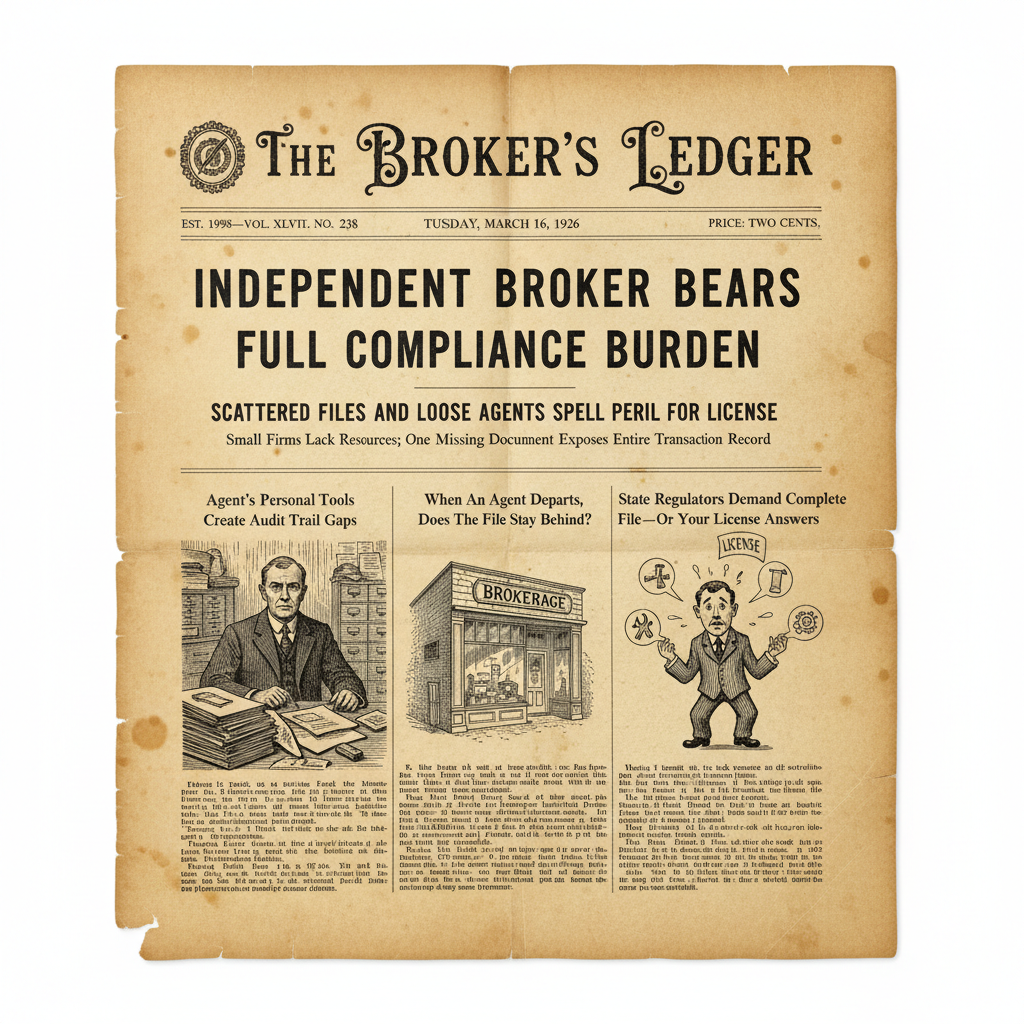
The Compliance Weight Falls on You
Running an independent brokerage means wearing a lot of hats. You recruit agents, manage deals, keep the lights on, and - at the top of that list - you carry the license. Every transaction your agents close flows through your broker-of-record status. When a file is incomplete, a disclosure is missing, or a document is stored in someone's personal inbox, that exposure is yours.
According to the NAR 2025 Profile of Real Estate Firms, 81% of firms operate a single office, and the average firm carries just 2 full-time licensees. That means most brokers of record are running lean - without a dedicated compliance officer, without a legal team on retainer, and without the corporate infrastructure that franchise networks rely on. The compliance responsibility is real, but the resources to manage it often are not.
Why Independent Brokerages Face Unique Risk
The structure of independent real estate firms creates specific compliance pressure points that larger operations absorb more easily.
- Agent independence: 86% of REALTORS are independent contractors at their firm (NAR 2026 Member Profile). That relationship gives agents flexibility - and it means they often manage their own files, tools, and workflows. When those habits vary agent to agent, consistent document retention becomes a serious challenge.
- Scattered tools: Many independent brokerages piece together a stack of separate tools - one for forms and contracts, another for e-signatures, another for MLS access, and maybe a CMA tool on top of that. When transaction data lives in five different platforms, audit trails are fragmented and retrieval during a dispute can be slow and painful.
- Rising costs and tight margins: 36% of firms cite rising industry costs as a top challenge over the next two years (NAR 2025 Profile of Real Estate Firms). Compliance tools are often the first thing cut when budgets tighten - right when firms need them most.
What Transaction Compliance Actually Requires
Compliance is not just about having the right forms. A defensible transaction file covers the full lifecycle of a deal:
- Complete, dated documentation - every disclosure, addendum, and amendment captured and time-stamped at the moment it was signed.
- Consistent Fair Housing practices - language in listings, marketing, and communications that never implies preference or limitation by any protected class.
- Secure, retrievable document storage - records accessible to the broker of record when a state commission, an arbitration panel, or a client's attorney comes asking.
- Audit-ready transaction history - a clear record of who did what, and when, across every deal in the office.
Each of those requirements gets harder to meet when your tools do not talk to each other and when your agents are managing pieces of the file in their own personal accounts.
The Agent Book-of-Business Problem
Here is a risk that does not always get named directly: when an agent leaves your firm, does their transaction history stay with your brokerage - or walk out the door with them?
For brokers of record, this is both a compliance issue and a business continuity issue. State regulations typically require that the broker retain transaction records, not the agent. If your office workflow runs through tools the agent controls personally, you may be exposed on both fronts the moment that agent moves to a competing firm.
Keeping agent activity inside a brokerage-controlled platform is not just good practice - it is part of meeting your record-retention obligations. The Real Estate Genie brokerage platform is designed specifically around this structure: the broker of record owns the system, and every agent on the roster works within it.
Technology Compliance Pressure Is Growing
34% of real estate firms cite keeping up with technology as a top challenge over the next two years (NAR 2025 Profile of Real Estate Firms). That pressure is not just about adopting new tools - it is about adopting the right tools in a way that reduces risk rather than adding it.
Adding a disconnected AI tool here, a separate e-signature vendor there, and a standalone forms platform on top of that does not solve compliance. It multiplies the number of places a file can fall through the cracks.
The more defensible approach is consolidation: contracts and forms, e-signature, CMA, and MLS access working together inside one platform - with an AI layer like Hoku handling drafting and busywork so nothing gets missed. One bill, one audit trail, one place to pull records when you need them.
What to Look For in a Compliance-Ready Platform
When evaluating tools for your brokerage, ask these questions:
- Does the broker of record retain control of all transaction records, even if an agent leaves?
- Are documents stored and retrievable in a format that satisfies state record-retention requirements?
- Does the platform support consistent, Fair Housing-compliant language across listings, marketing, and communications?
- Is there a single audit trail that covers the full transaction lifecycle?
- Does consolidating tools here actually reduce what you pay across your current stack?
If any of those answers is uncertain, the gap is worth closing before a dispute surfaces it for you. You can compare what Real Estate Genie replaces against your current stack, or take a look at brokerage pricing to see what consolidation actually costs.
Compliance Is Not a Feature - It Is a Foundation
For a broker of record running a lean independent firm, compliance is not optional and it is not something you can solve by adding another tool to an already fragmented stack. It requires a platform where the broker owns the data, the agents work inside a controlled environment, and every transaction leaves a clean, retrievable record.
With more than 300,000 real estate firms operating in the U.S. (NAR 2025 Profile of Real Estate Firms) - most of them small, independent, and running on tight margins - the firms that build compliance into the foundation of how they operate are the ones best positioned to protect their license and grow with confidence. See how Real Estate Genie is built for exactly that.
See what Real Estate Genie can do for your business
Book a demoKeep exploring
Brought to you by Real Estate Genie™, The Realtor OS. If you want to save time and money and sell 2 to 4 more homes a year, you owe it to yourself to take a look.