July 21, 2026
The States Are Coming for Private Listings. Here's What Every Agent Needs to Know.
State laws are rewriting private listing rules. Three regulatory models, five states, and what every agent must change before 2027.
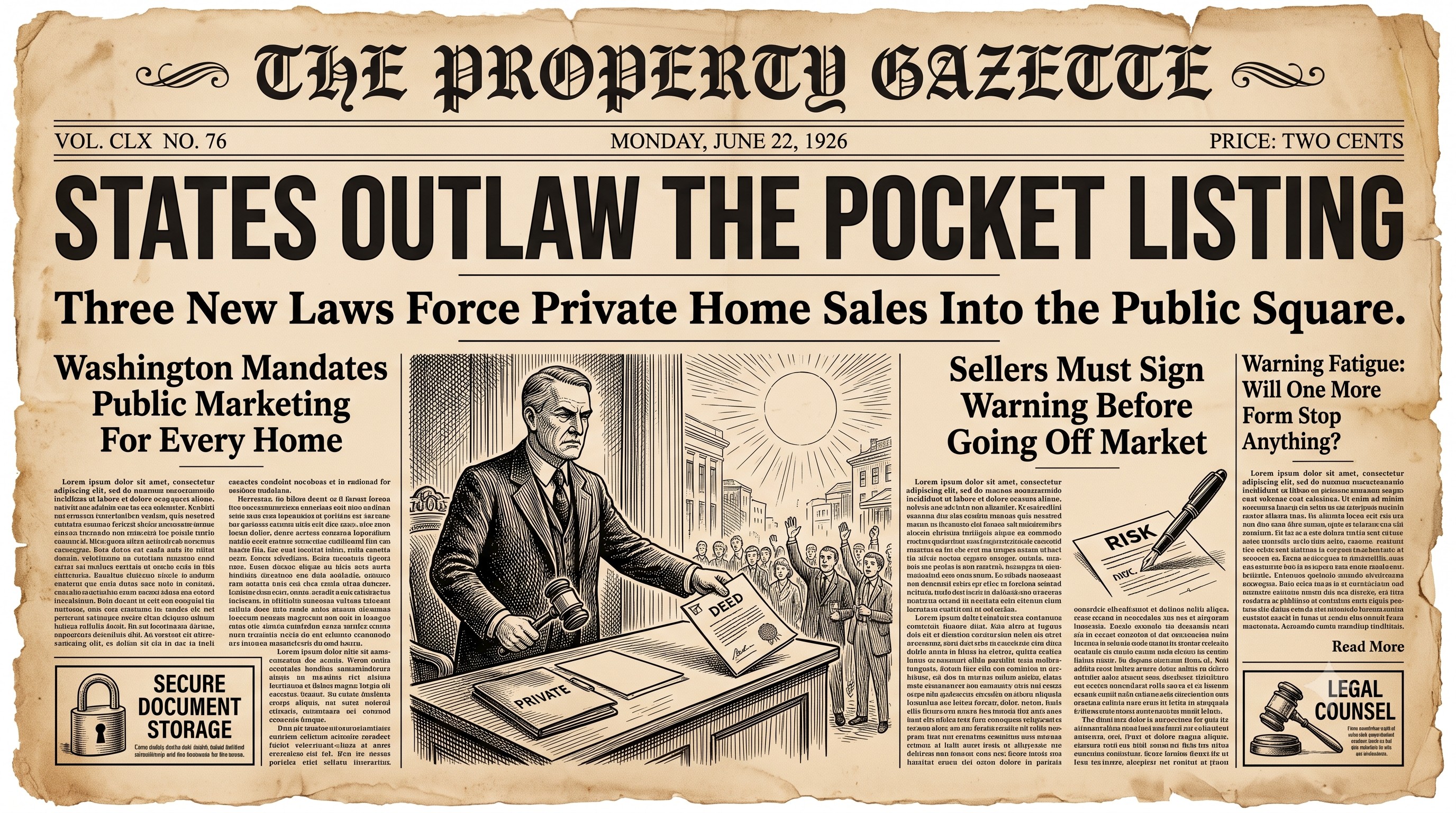
Five States Have Passed Legislation To Limit Private Listings
For the last two years, the fight over private listings has mostly been an industry family feud. NAR against its critics. Compass against Zillow. Brokerages against MLSs. Everyone arguing about Clear Cooperation like it was the only rulebook that mattered.
That era is over. State legislatures have entered the chat, and they are not asking NAR for permission.
In a June 2026 opinion piece for HousingWire, attorney Anthony V. Mannino laid out something that most agents have not fully absorbed yet: states are now converging on three distinct regulatory models for private listings, and the differences between those models will shape how you list homes for the next decade. Washington's law is already in effect. Connecticut takes effect October 1, 2026. Wisconsin follows on January 1, 2027. New York is one procedural step from the finish line. And here in Hawaii, our own bill cleared the Senate unanimously before the session ran out, which means it is coming back in January.
If you sell real estate for a living, this is not background noise. This is the ground shifting under your listing presentation. Let's break down how we got here, what the three models actually say, and what it means for how you run your business.
How We Got Here: A Quick Refresher
To understand why state lawmakers are writing real estate marketing rules, you have to rewind to the fight that made this a national story.
NAR's Clear Cooperation Policy, in effect since 2020, requires that any property publicly marketed by a Realtor be submitted to the MLS within one business day. The policy was designed to stop pocket listings from fragmenting the market. But it always contained a carve-out for "office exclusives," listings marketed only inside a single brokerage, and that carve-out became the foundation of an entire business strategy.
Compass leaned into it harder than anyone. The brokerage built a three-phase marketing plan where listings start life as "private exclusives" visible only to Compass agents and their buyers, then graduate to "coming soon," then finally hit the open market. Compass CEO Robert Reffkin argued that Clear Cooperation limits homeowner choice and punishes sellers by broadcasting negative signals like days on market and price cuts. In a November 2024 earnings call, he predicted a future where buyers would search Compass, the MLS, and a couple of aggregators separately to find inventory, the way you might shop multiple retailers for any other product.
Zillow saw an existential threat and responded with force, criticizing private listing networks for creating what it called manufactured scarcity. The company argued that keeping homes off the open market limits families' ability to compete for homes in their budget and causes sellers to lose out on their best offers by artificially shrinking the buyer pool.
NAR tried to split the difference. In March 2025, it announced the Multiple Listing Options for Sellers policy, which kept Clear Cooperation but created a new category called "delayed marketing exempt listings." Under that option, a seller can instruct their agent to enter the listing in the MLS within the standard one-day window while delaying its distribution through IDX feeds and syndication to portals like Zillow, Realtor.com, and Homes.com for a period set by each local MLS. Both the delayed marketing option and office exclusives require the seller to sign a disclosure acknowledging the tradeoffs of reduced exposure.
Nobody was fully satisfied. Compass didn't get Clear Cooperation repealed. Zillow announced that any listing publicly marketed but not added to the MLS within its window would be banned from its platform. Lawsuits flew, including Compass suing NWMLS, the big non-Realtor-affiliated MLS in the Pacific Northwest that never allowed office exclusives in the first place.
And while the industry fought itself, state legislators watched and reached a conclusion that should make every association executive sit up straight: if the industry cannot settle this internally, the states will settle it in statute.
The Three Models States Are Using
Mannino's HousingWire analysis identifies three regulatory structures emerging across the country. He frames them regionally, and the geography holds up surprisingly well.
Model 1: The Mandate (Washington, and Hawaii's proposal)
Washington took the most direct route available. Senate Bill 6091, signed by Governor Bob Ferguson in mid-March 2026 and effective June 11, 2026, amends the state's real estate brokerage law to require that residential listings be marketed broadly to the general public. The operative language is blunt:
"A broker may not market the sale or lease of residential real estate to a limited or exclusive group of prospective buyers or brokers, or any combination thereof, unless the real estate is concurrently marketed to the general public and all other brokers, except as reasonably necessary to protect the health or safety of the owner or occupant."
Notice what is missing: there is no opt-out form. There is no disclosure a seller can sign to unlock private marketing. Public exposure is simply the default, and the only exception is a genuine health or safety concern. The law passed with nearly unanimous bipartisan support, was championed by Washington Realtors as priority legislation, and carries real teeth, with fines up to $500 per violation and license revocation on the table. Notably, the law does not force sellers to let buyers into their homes. It regulates marketing, not access.
Mannino calls this "the cleanest regulatory posture," and he is right. It does not ask consumers to read and understand a warning. It removes the decision entirely.
Hawaii's Senate Bill 2806 follows the same philosophy and arguably goes further. The bill would prohibit brokers from listing or offering residential property to a limited or exclusive group and would deem the practice an unfair or deceptive trade practice, exposing agents to disciplinary penalties. It passed the Hawaii Senate 25 to 0 in March 2026 before stalling in a House committee when the session ended. Because our legislature does not reconvene until January, the issue is parked, not dead. Sponsors include Senators Donovan Dela Cruz, Michelle Kidani, Rachele Fernandez Lamosao, and Chris Lee, and given the unanimous Senate vote, I would not bet against a version of this becoming law in 2027.
The Hawaii angle matters beyond our shores, too. Local brokers have told reporters that a meaningful share of higher-end transactions here never touch a public MLS feed at all. If a whisper-network market as entrenched as Hawaii's luxury segment can be legislated into the open, any market can.
Model 2: The Legislature Writes the Warning (Connecticut and New York)
Connecticut and New York took the opt-out path. Sellers can still choose private marketing, but only after receiving and signing a disclosure spelling out the risks. The twist is that the legislature itself wrote the warning language directly into the statute.
Connecticut's law, passed in mid-2026 and effective October 1, requires public marketing within one day of a listing agreement unless the seller signs the statutory disclosure. The Connecticut form makes the seller acknowledge that skipping public marketing may reduce competition, may result in fewer offers, and may hurt the final price and terms. It even includes a line stating that limiting buyer tours "may not be in the Seller's best financial interest." Both Connecticut Realtors and Zillow testified in favor of the bill.
New York's version, which has passed both chambers and awaits final ratification, puts the warning in the first person and in capital letters, so the seller is essentially reading their own confession of risk before signing: an acknowledgment that reducing exposure may reduce offers and could negatively impact the seller's ability to sell sooner, on better terms, at a higher price.
The theory behind this model is informed consent. Sellers keep their freedom, but the listing agent is legally required to deliver the counterargument to their own private listing pitch. As Mannino puts it, the law derives its force from making the agent tell the client the drawbacks, not just the marketing story.
Model 3: The Agency Drafts the Form (Wisconsin and Illinois)
Wisconsin and Illinois also chose the opt-out route, but with a bureaucratic difference that Mannino flags as small but meaningful: instead of writing the warning language into the law, the legislature delegates the form's creation to oversight agencies or real estate associations, with general instructions to explain the benefits of public marketing and the drawbacks of limiting exposure.
Wisconsin's law, signed by Governor Tony Evers in December 2025, makes public marketing the accepted default and takes effect January 1, 2027. Illinois has a similar measure waiting for its legislature to reconvene.
Why does the drafting question matter? Because statutes are hard to change. Legislative sessions are short, calendars are crowded, and amending a law can take years. An agency-drafted form can be revised quickly as market conditions evolve, but that same flexibility means it is also more exposed to lobbying pressure from every direction. Whoever controls the form controls how scary the warning sounds, and that is a fight that will happen in rulemaking meetings most agents will never hear about.
The Big Question: Will Opt-Out Forms Actually Stop Anything?
Here is where Mannino's analysis gets genuinely interesting, and where I think agents should pay closest attention.
The mandate states leave no room for debate. In Washington, if you market a listing to a private network without concurrent public marketing and you cannot point to a health or safety justification, you are breaking state law. Full stop.
But the opt-out states are running a different experiment, and its outcome is far from certain. The entire mechanism depends on a seller actually reading and absorbing a warning at the exact moment they are drowning in paperwork. Think about what listing day looks like from the client's side of the table: an agency agreement, consumer notices, an affiliated business disclosure, and a stack of signature lines that starts to blur together. Mannino calls this "warning fatigue," and every agent who has watched a client initial fifteen pages in four minutes knows exactly what he means. One more government-required form can easily become one more initial on one more line.
His conclusion is the sharpest sentence in the piece: opt-out forms may end up functioning more as liability protection for brokerages than as any real impediment to a private listing strategy. In other words, the disclosure may not change seller behavior at all. It may simply give the brokerage a signed piece of paper to wave when a seller later complains that their quietly marketed home sold for less than the neighbor's.
If that prediction holds, we will end up with a country split in two. In mandate states, private listing networks effectively cannot operate as a primary strategy. In opt-out states, they can operate almost exactly as before, with one extra signature in the stack.
What This Means for Working Agents
Let me take off the analyst hat and put on the practitioner hat, because this is where it gets real for the people I build software for.
First, know which regime you are in, and which one is coming. Effective dates are staggered: Washington is live now, Connecticut arrives October 1, 2026, Wisconsin on January 1, 2027, New York is pending ratification, and Hawaii and Illinois resume in January. If you work in one of these states or near one, your compliance obligations are about to change on a specific date, and "I didn't know" has never once worked as a defense in a license hearing. Washington's law authorizes fines and license suspension. Hawaii's bill would brand the practice an unfair or deceptive trade practice, which is the kind of label that follows you into civil litigation.
Second, your listing presentation needs a rewrite. In opt-out states, you will be legally required to walk your seller through the downsides of private marketing before they can choose it. Smart agents will get ahead of this instead of treating it as an awkward compliance moment. Build the conversation into your process: here is what public marketing does for your buyer pool, here is what the data says about off-MLS sale prices, here is the form the state requires if you still want to go private. An agent who explains the tradeoff confidently looks like a fiduciary. An agent who shoves a form across the table looks like they are hiding something.
Third, watch what this does to inventory and your prospecting. Realtor.com senior economist Joel Berner made the point about Washington directly: if private listings suddenly become public, available inventory ticks up, buyers get more options and more time to shop, and the perceived scarcity of homes for sale diminishes because the public can finally see the entire for-sale universe. For buyer's agents in mandate states, that is unambiguously good news. The whisper-network disadvantage, where the agents inside the right brokerage saw inventory you never did, gets legislated away. For listing agents who built a value proposition around exclusive access, the pitch has to evolve from "I can get you into the private club" to "I can position and market your home better than anyone."
Fourth, do not assume your MLS rules and your state law say the same thing. Washington is the cautionary tale here. NWMLS rules already prohibited office exclusives and required submission within one business day, so brokers inside its footprint felt little change. But NWMLS does not cover the whole state, and markets like Spokane operated under Clear Cooperation's more permissive framework. SB 6091 exists precisely to erase that patchwork by binding every licensee through state licensing law, regardless of MLS membership. Expect the same dynamic elsewhere: the statute becomes the floor, and your MLS rules sit on top of it.
Fifth, expect this list of states to grow. Mannino notes we probably will not see new states jump in immediately because most legislatures have short sessions. But the template now exists in three flavors, Zillow and state Realtor associations have shown they will lobby for these bills, and Washington's near-unanimous bipartisan vote tells other statehouses this is politically safe ground. When legislatures reconvene in January 2027, I expect Hawaii and Illinois to finish what they started and a handful of new states to file copycat bills.
My Take: The Off-Market Era Is Being Regulated Into a Niche
I will be honest about where I stand. I built Real Estate Genie in Hawaii, a market where off-market deal flow is practically a cultural institution, and I still think this wave of legislation is directionally right.
The private listing boom was never really about seller choice. It was about brokerage inventory control. When a listing starts life inside one company's walls, the brokerage gets first crack at both sides of the deal, and the seller pays for that convenience with a smaller buyer pool. The Connecticut and New York disclosure language is essentially the legislature forcing that math into the open.
But I also think Mannino's warning-fatigue point deserves to be taken seriously. Disclosure regimes have a long history of protecting institutions better than they protect consumers. If the opt-out states discover in two years that private listing volume never dropped, the next legislative round will look a lot more like Washington's mandate and a lot less like a form.
Either way, the direction of travel is unmistakable. The regulatory risk of building your business on private inventory is rising every session. The agents who win the next five years will be the ones who treat transparency as their marketing advantage instead of their compliance burden, who can sit across from a seller and explain exactly why maximum exposure produces maximum price, and who have systems in place to execute a public launch flawlessly on day one.
The states have made their opening move. Three models are on the board. Your job now is to know which one governs your market, and to build a listing process that would survive scrutiny under any of them.
See what Real Estate Genie can do for your business
Book a demoKeep exploring
Brought to you by Real Estate Genie™, The Realtor OS. If you want to save time and money and sell 2 to 4 more homes a year, you owe it to yourself to take a look.