July 11, 2026
Who Wins With Private Listings?
Private listings are dividing the real estate industry. Before you agree to one, here is what every agent and seller should know about who actually benefits.
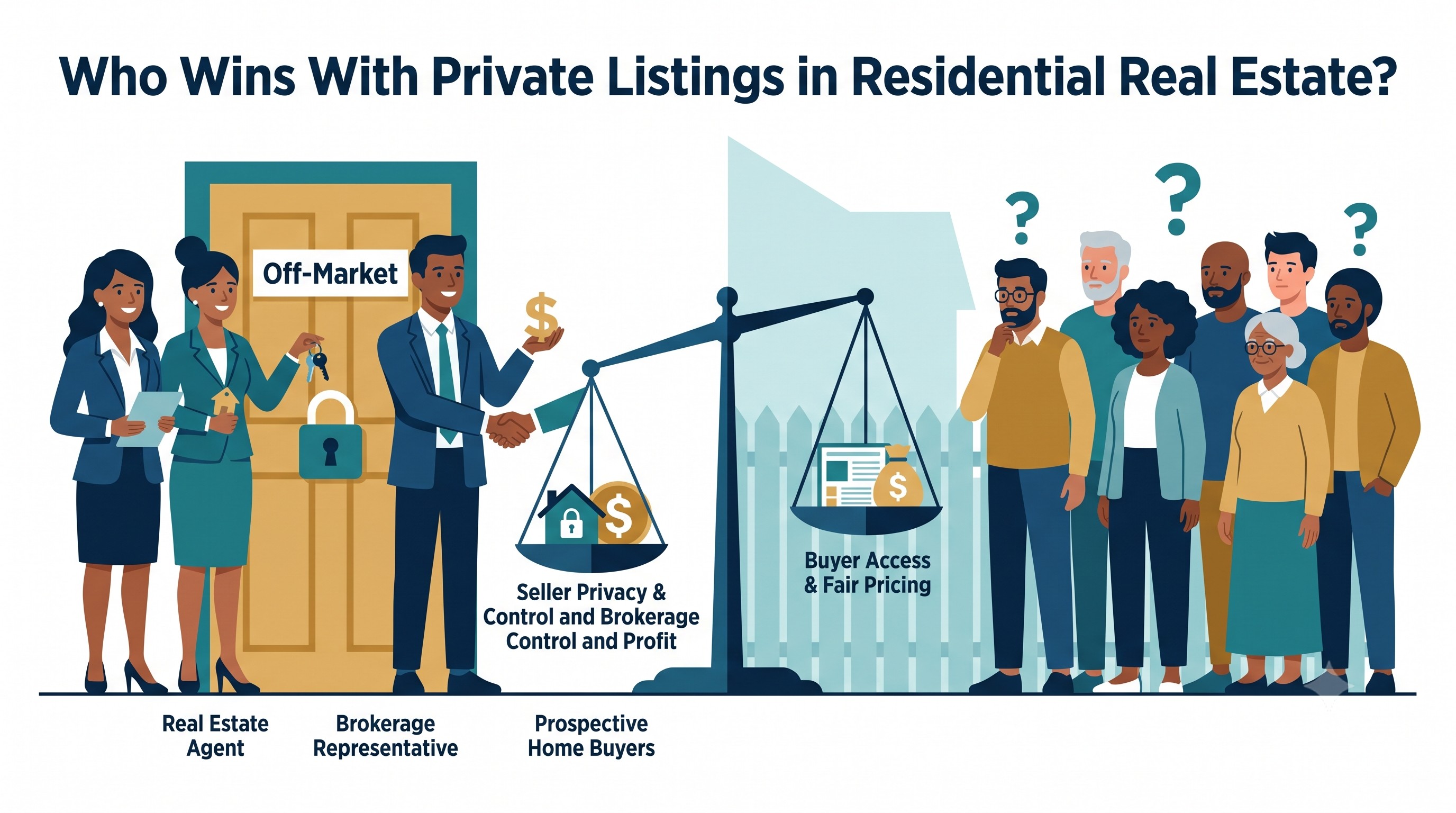
Private Listings - Who Wins?
Private listings - sometimes called pocket listings or off-market properties - have never generated more debate than they do right now. For some sellers, the idea of keeping a home out of the public MLS sounds appealing. For others, it raises serious questions about fairness and results. Before you commit to a strategy either way, it is worth asking a blunt question: who actually wins when a home sells privately?
What Is a Private Listing?
A private listing is a property that is marketed without being entered into the regional MLS. The listing agent may share it with a select network of buyers, colleagues, or investors before - or instead of - making it broadly available. The seller typically signs an agreement acknowledging they are opting out of the widest possible exposure.
Private listings are legal in most markets, but industry rules have tightened in recent years to require sellers to actively choose this route in writing rather than have it happen by default.
The Case for the Seller
Sellers are often drawn to private listings for a handful of genuine reasons:
- Privacy: Public figures, executives, and anyone who values discretion may not want photos of their home circulating online or strangers walking through on open-house weekends.
- Convenience: Some sellers want to test a price or gauge interest before committing to the full showing-and-offer process.
- Speed: In a market where the listing agent already knows a motivated, ready buyer, a private deal can close faster with less disruption.
These are real benefits - but they come with a real trade-off.
What Sellers Often Give Up
The MLS exists for one primary reason: to expose a property to the largest possible pool of qualified buyers. More competition among buyers generally means stronger offers. When you remove a home from that system, you are almost always reducing competition, and reduced competition typically means a lower sale price.
Research across multiple housing markets has consistently shown that homes sold on the MLS tend to command higher prices than comparable off-market sales. The difference can be meaningful, sometimes representing tens of thousands of dollars depending on the market.
A seller who values privacy is making a legitimate choice - as long as they fully understand the financial trade-off they may be accepting.
Sellers should also consider that a quick, quiet sale with fewer offers gives them less negotiating leverage on contingencies, timelines, and repairs.
Who Else Benefits - and How
Here is where the conversation gets more complicated. Private listings can create clear advantages for parties other than the seller:
Buyers with insider access
A buyer who has a relationship with the listing agent - or whose agent runs in the right circles - gets a head start on the competition. That is genuinely valuable for the buyer, but it means every other qualified buyer never gets a chance to compete.
Listing agents
When the listing agent also represents the buyer, they earn both sides of the commission. That is a significant financial incentive that exists regardless of whether a dual-commission deal is actually in the seller's best interest.
Investor networks
Investors who cultivate off-market deal flow benefit because they can acquire properties at prices that have not been tested by the open market. A low acquisition price is good for the investor's returns - and it often comes at the seller's expense.
The Fair Housing Dimension
Private listing networks can also raise Fair Housing concerns. When properties are shared only within a small, informal network, the question of who gets access to that network - and who does not - deserves scrutiny. Regulators and consumer advocates have flagged that off-market pipelines can inadvertently reinforce patterns of unequal access to housing opportunity. Agents should be thoughtful about how their private listing practices hold up against Fair Housing obligations.
When a Private Listing Actually Makes Sense
To be clear, there are situations where a private sale is a reasonable, well-informed choice:
- The seller has been presented with a verifiably strong offer before the listing goes live and prefers certainty over competition.
- The property has characteristics - unique price point, unusual use, occupant sensitivity - where limited exposure is genuinely preferable.
- The seller has received a thorough, written explanation of the potential financial impact and has chosen privacy or speed over maximum price.
The key word in every case is informed. A seller who chooses a private listing after understanding the full picture is exercising their right. A seller who is steered toward one without that conversation is not being well-served.
What Great Agents Do
Top-performing agents treat private listings as an option, not a default. They use every tool available - including platforms like Real Estate Genie™ that bring their marketing, client communication, and property data together in one place - to make sure their sellers have a complete picture before making the call.
A seller who feels rushed into a quiet sale may close quickly and then spend years wondering if they left money on the table. A seller who makes a genuinely informed choice - whatever it is - becomes a loyal referral source for life.
Private listings are not inherently wrong. But transparency about who benefits, and who absorbs the cost, is non-negotiable. The best agents in the business know the difference.
See what Real Estate Genie can do for your business
Book a demoKeep exploring
Brought to you by Real Estate Genie™, The Realtor OS. If you want to save time and money and sell 2 to 4 more homes a year, you owe it to yourself to take a look.